
What is the official portal for Indian Government Tenders?
Introduction:
Government Tenders in India offer one of the largest and most reliable business opportunities for suppliers, contractors, manufacturers, consultants and service providers. Every year, Central Government ministries, State Government departments, Public Sector Undertakings (PSUs), municipal corporations and autonomous bodies publish thousands of government tenders for infrastructure projects, IT services, healthcare, defence, education, transportation, renewable energy, manpower, consultancy and the procurement of goods and services. These opportunities are made available through various government tender portals such as the Government e-Marketplace (GeM), Central Public Procurement Portal (CPPP) and state eProcurement systems.
However, participating in Government Tenders in India is much more than simply finding a tender notice and submitting a price quote. Businesses must understand eligibility criteria, vendor registration, Digital Signature Certificates (DSC), Earnest Money Deposit (EMD), tender documents, technical and financial bids, procurement rules, evaluation methods and compliance requirements before they can successfully compete for government contracts. Whether you are an MSME, startup, manufacturer, contractor or established enterprise, understanding the complete government procurement process can significantly improve your chances of winning public sector business.
This comprehensive guide has been created to serve as a one-stop knowledge hub for anyone looking to understand Government Tenders Online in India. From learning the fundamentals of public procurement and exploring different types of tenders to registering on GeM and CPPP, understanding tender terminology, navigating procurement portals, avoiding common bid mistakes and preparing successful bids, this guide covers every stage of the government tendering lifecycle in a practical and structured manner.
In addition to explaining how the Indian public procurement system works, this guide also connects you with detailed resources on tender documents, procurement regulations, GeM bidding, eTendering, state procurement portals and other specialised topics published on IndianTenders.in. Whether you are participating in your first government tender or looking to improve your bidding success rate, this guide will help you make informed decisions and confidently navigate India's rapidly evolving digital procurement ecosystem.
Who Should Read This Guide?
- MSMEs looking to win Government Tenders
- Startups entering public procurement
- Civil, Electrical and EPC Contractors
- Manufacturers and OEMs supplying to Government Departments
- IT, Healthcare and Consultancy Service Providers
- Businesses registering on GeM or CPPP
- First-time bidders learning the government tender process
- Procurement professionals and bid managers
Detailed Table of Contents
- 01. Introduction to Government Tenders in India
- 02. Understanding Government Procurement
- 03. Types of Government Tenders
- 04. Government Procurement Portals in India
- 05. Major Tendering Authorities
- 06. Who Can Apply for Government Tenders?
- 07. Eligibility Requirements & Checklist
- 08. Step by Step Vendor Registration Process
- 09. Tender Documents Explained
- 10. Key Tender Terminology Explained
- 11. Complete End to End Tender Lifecycle
- 12. Digital Signature Certificate (DSC) Masterclass
- 13. Government e Marketplace (GeM) Deep Dive
- 14. Central Public Procurement Portal (CPPP) Guide
- 15. State eProcurement Portals Overview
- 16. Tender Evaluation Methodologies
- 17. Common Reasons Bids Get Disqualified
- 18. Government Procurement Rules & Statutory Frameworks
- 19. Benefits of Bidding for Government Contracts
- 20. Common Challenges Faced by Contractors & Vendors
- 20A. How to Improve Your Success Rate in Government Tenders
- 21. How IndianTenders.in Empowers Your Bidding Success
- 22. Latest Government Tender Trends (2026-27)
- 23. The Complete Procurement & Bidding Lifecycle
- 24. 15 Fatal Mistakes Every First Time Bidder Makes
- 25. The Ultimate Pre Submission Tender Checklist
- 26. Top Industries with Maximum Public Sector Procurement
- 27. Official Procurement Statistics & Data Brief (2026-27)
- 28. Future Outlook: AI, Automation, & Green Procurement
1. Introduction to Government Tenders in India
What are Government Tenders?
A Government Tender is a formal, transparent invitation issued by a government authority, public sector undertaking (PSU), local body or defense department requesting competitive offers from qualified suppliers, contractors, service providers or manufacturers. Whether constructing a multi lane expressway, procuring life saving medical equipment, deploying cloud IT infrastructure or outsourcing facility maintenance, public bodies must purchase goods, services and civil works through structured tendering rather than private negotiations.
Why Government Procurement Matters
Public procurement is the engine of national economic growth. In a developing economy like India, government spending builds physical infrastructure, fuels industrialization, promotes innovation and sustains millions of enterprises ranging from local micro units to blue chip conglomerates. By adopting transparent digital frameworks, government tendering ensures:
- Optimal Utilization of Public Funds: Generating maximum value for taxpayers through competitive price discovery.
- Level Playing Field: Guaranteeing that every qualified Indian business gets an equal opportunity to compete.
- Socio Economic Objectives: Promoting domestic manufacturing under the Make in India mandate and supporting Micro and Small Enterprises (MSEs) and Women/SC/ST led startups.
The scale of government procurement in India is colossal:
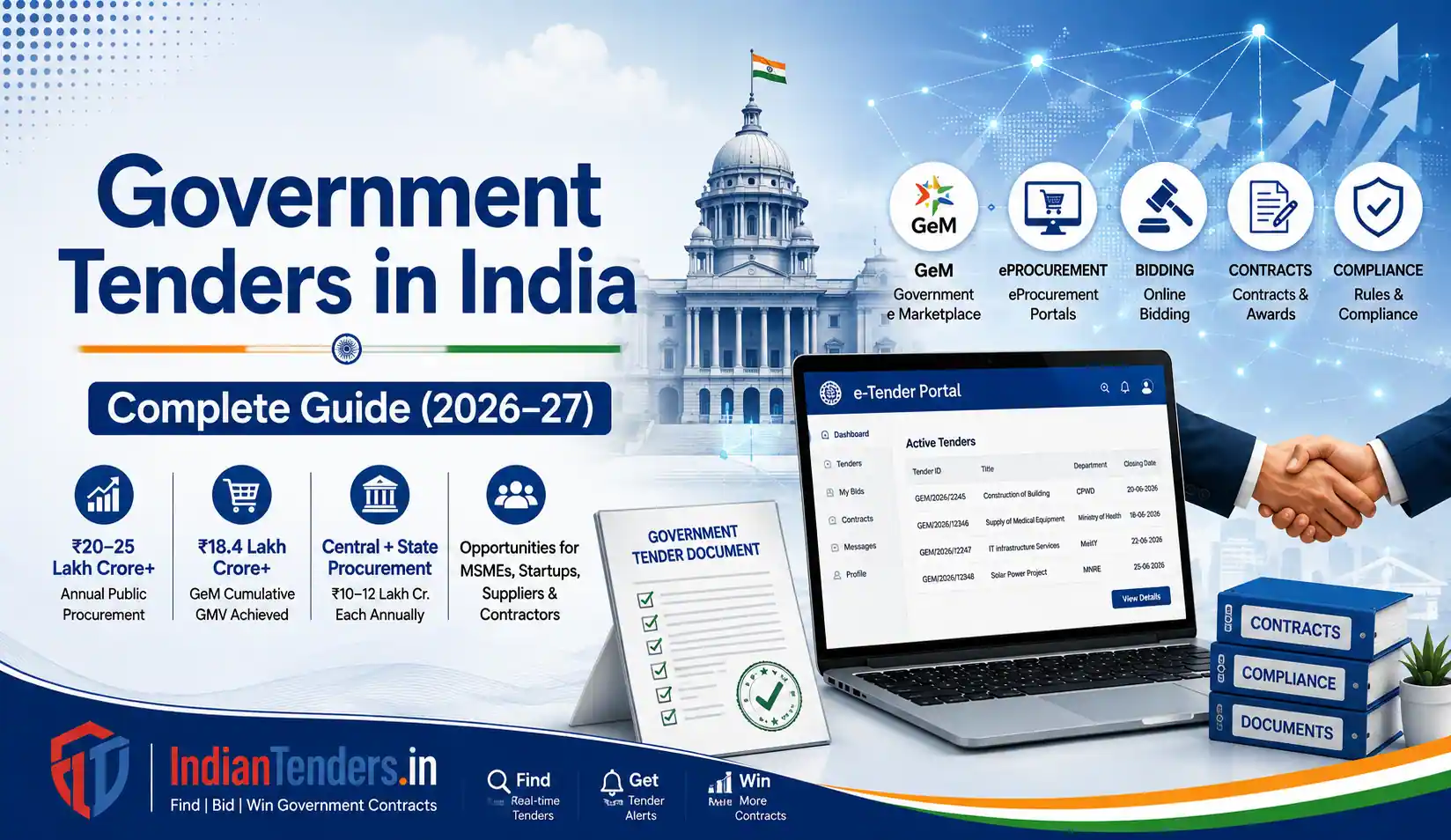
- Total Annual Expenditure: Indian public procurement is estimated at ₹20 Lakh Crore to ₹25 Lakh Crore ($240B-$300B+) annually, representing 15% to 20% of India's GDP.
- GeM Portal Growth: The Government eMarketplace (GeM) achieved a cumulative Gross Merchandise Value (GMV) of over ₹18.4 Lakh Crore, consistently crossing ₹5 Lakh Crore in single fiscal year transactions.
- Central vs. State Share: Central Ministries, Defense, Railways and CPSEs account for nearly ₹10-12 Lakh Crore annually, while 28 State Governments and Union Territories collectively publish procurement contracts worth over ₹10 Lakh Crore each year.
2. Understanding Government Procurement
What is Public Procurement?
Public procurement refers to the overarching process by which public sector organizations acquire goods, services and execution of works using public capital. Unlike private procurement , where decisions can rely on personal preferences or informal negotiations , public procurement is bound by strict statutory frameworks like the General Financial Rules (GFR 2017), CVC guidelines and state specific procurement acts to prevent corruption and favoritism.
How Government Purchasing Works
Public purchasing operates under a multi stage lifecycle governed by law:
- Need Identification & Budget Allocation: An authority identifies a public requirement (e.g., building a bridge or supplying laptops) and secures administrative and financial sanction.
- Standardisation & RFP Formulation: Technical experts draft detailed technical specifications, terms of reference (ToR) and financial evaluation criteria.
- Public Advertisement: The procurement notice is published on authorized platforms like GeM, CPPP, State eProcurement portals and newspapers.
- Competitive Bidding: Vendors submit encrypted technical and financial proposals before a strict deadline.
- Two Cover Evaluation: Technical bids are unsealed and scrutinized first. Price bids (BOQs) of technically qualified vendors are opened publicly online.
- Award & Contract Signing: The contract is awarded to the lowest eligible bidder (L1) or highest quality cost scorer (QCBS).
Who Can Participate?
Public procurement is open to a wide array of legal business structures:
- Sole Proprietorships & Registered Partnership Firms
- Private Limited & Public Limited Companies
- Micro, Small and Medium Enterprises (MSMEs) with UDYAM Registration
- DPIIT Recognized Startups
- Registered Civil, Electrical, & Mechanical Contractors
- Original Equipment Manufacturers (OEMs), Authorized Dealers and Service Integrators
- Foreign entities (subject to Global Tender Enquiry threshold rules)
3. Types of Government Tenders
Understanding tender classifications helps bidders choose the right strategy and prepare appropriate documentation.
| Tender Type | Primary Use Case | Key Features | Threshold / Criteria |
|---|---|---|---|
| Open Tender | Public works, large equipment purchases, major service contracts. | Open to all eligible suppliers nationwide; advertised publicly. | Generally used for tenders above ₹2.5 Lakhs (or stat edefined thresholds). |
| Limited Tender | Urgent requirements or specialized services with limited suppliers. | Bids requested directly from a short listed panel of pr eempanelled vendors. | Used when value is generally below ₹25 Lakhs or emergency situations exist. |
| Single Tender / PAC | Proprietary equipment, specialized spare parts, OEM locked repairs. | Awarded to a single manufacturer/vendor under a Proprietary Article Certificate. | Requires strict technical justification from the department head. |
| Global Tender Enquiry (GTE) | High tech machinery, specialized defense gear, mega infrastructure. | Foreign suppliers allowed to participate alongside domestic bidders. | Restricted for tenders below ₹200 Crores under Make in India rules (requires special cabinet approval). |
| GeM Bids | Routine goods, services and custom requirements for all public entities. | Electronic bidding, direct purchase or reverse auctions hosted on the GeM portal. | Mandatory for all Central Ministries, CPSEs and participating state bodies. |
| Expression of Interest (EoI) | Architectural designs, complex IT projects, consultancy work. | Pr equalification stage to gauge market interest and shortlist competent firms before RFP issuance. | No financial quote requested in this initial technical screening phase. |
| Reverse Auction (RA) | Standardized goods, solar power tariffs, bulk commodities. | Real time electronic bidding where vendors progressively lower prices against L1 within a set window. | Conducted online after technical evaluation is finalized. |
4. Government Procurement Portals in India
To participate effectively, contractors and vendors must register on the primary digital procurement platforms used across India:
- Government eMarketplace (GeM): The flagship online portal (gem.gov.in) for all common use goods and services required by Central and State Government departments, Ministries and CPSEs.
- Central Public Procurement Portal (CPPP): The primary eProcurement portal (eprocure.gov.in) managed by NIC for publishing high value tenders, civil works and specialized RFPs issued by Central Government bodies.
- State eProcurement Portals: Individual eProcurement systems operated by 28 State Governments and Union Territories (e.g., Mahatenders, eProc Karnataka, Tenders Odisha, eProc UP).
- PSU & Specialized Portals: Independent etendering portals operated by major Central Public Sector Enterprises such as NTPC, IOCL, ONGC and Coal India.
- Indian Railways eProcurement System (IREPS): The dedicated portal (ireps.gov.in) handling all railway materials procurement, rolling stock tenders, leasing and civil engineering contracts.
Comparison of Major Government Tender Portals in India
India's public procurement ecosystem operates through multiple Government Tender Portals, each serving a specific purpose. While some portals focus on central government procurement, others manage state-level tenders, railway contracts, defence procurement or PSU purchasing. Understanding the role of each portal helps businesses identify the right opportunities and choose the most appropriate platform for bidding.
| Portal | Primary Purpose | Who Uses It? | Best For |
|---|---|---|---|
| GeM (Government e-Marketplace) | Online procurement of goods and services by Government buyers | Central & State Government Departments, PSUs, Autonomous Bodies | Product suppliers, service providers, MSMEs and startups |
| CPPP (Central Public Procurement Portal) | Publishing and managing Central Government eTendering | Central Ministries, CPSEs and Government Organisations | High-value works, EPC projects, consultancy and infrastructure tenders |
| State eProcurement Portals | State Government procurement and eTendering | State Departments, Municipal Corporations and Local Authorities | Roads, buildings, water supply, healthcare and state infrastructure projects |
| IREPS | Indian Railways eProcurement platform | Indian Railways and Railway Production Units | Railway materials, civil works, signalling and rolling stock procurement |
| PSU Procurement Portals | Procurement by individual Public Sector Undertakings | NTPC, ONGC, IOCL, NHPC, Coal India, BHEL, BEL and others | Sector-specific procurement opportunities across energy, oil & gas, defence and manufacturing |
For businesses looking to maximise opportunities, relying on a single portal is rarely sufficient. Government tenders are published across GeM, CPPP, state eProcurement systems and various PSU procurement portals. Regularly monitoring multiple Government Tender Portals helps suppliers discover more opportunities, avoid missing important tenders and participate in a wider range of Government Tenders Online.
Procurement Tip for Businesses: Government procurement opportunities in India are published across multiple platforms rather than on a single website. Depending on the buying authority and procurement method, a tender may appear on the Government e-Marketplace (GeM), Central Public Procurement Portal (CPPP), a State eProcurement Portal, IREPS (Indian Railways) or the dedicated procurement portal of a Public Sector Undertaking (PSU).Manually checking every portal every day can be time consuming and increases the risk of missing important opportunities. Businesses that actively participate in Government Tenders Online generally benefit from using a centralized tender discovery platform that helps them track tenders across multiple government procurement sources, monitor corrigenda, receive tender alerts and identify opportunities relevant to their products or services.
IndianTenders.in helps businesses simplify this process by providing a single platform to discover government tenders published by Central Government Ministries, State Governments, PSUs, Municipal Bodies, Railways, Defence organisations and GeM, enabling suppliers, contractors and MSMEs to monitor procurement opportunities more efficiently.
5. Major Tendering Authorities
A substantial portion of national public procurement spending originates from key central infrastructure agencies, energy CPSEs and state departments:
Central Infrastructure & Highways- Central Public Works Department (CPWD): India's premier government construction agency, spending tens of thousands of crores annually on government residential projects, institutional buildings and border infrastructure.
- National Highways Authority of India (NHAI): Procures EPC (Engineering, Procurement, Construction) and HAM (Hybrid Annuity Model) contracts for national expressways and highway corridors worth over ₹1.5 Lakh Crore annually.
- NTPC Limited & NHPC: Major spenders in thermal, hydro and massive utility scale solar/wind renewable energy infrastructure.
- Power Grid Corporation of India (PowerGrid): Procures high voltage transmission lines, substations and smart grid automation systems.
- Indian Oil Corporation (IOCL) & ONGC: Massive procurers of industrial valves, pipelines, drilling equipment, refinery maintenance and offshore services.
- Indian Railways: Executes capital expenditures exceeding ₹2.5 Lakh Crore annually for track renewal, station redevelopment, Vande Bharat train manufacturing, electrification and signaling.
- Bharat Electronics Limited (BEL): Major procurer of electronics, defense hardware sub assemblies, radar components and IT systems.
- State PWDs & Urban Local Bodies: State Public Works Departments (PWDs), Water Authorities (e.g., WATCO, KWA) and Municipal Corporations (BMC, DDA, BBMP) spend over ₹8-10 Lakh Crore collectively on roads, water supply schemes and urban renewal projects.
6. Who Can Apply for Government Tenders?
Government tendering is not limited to mega corporations. Specialised quotas, relaxed rules and procurement policies allow diverse business entities to win contracts:
- Micro, Small & Medium Enterprises (MSMEs): Enjoy exemptions from Tender Fees and Earnest Money Deposits (EMD), along with mandatory 25% public procurement allocation rules and price preference bands (L1 + 15%).
- DPIIT-Recognised Startups: Receive relaxations on prior financial turnover and prior experience conditions, provided they meet technical quality parameters.
- Registered Civil & Electrical Contractors: Classified under grades (Super Class, Class A, B, C, D) by State PWDs, CPWD or Military Engineer Services (MES) based on solvency and past project completion values.
- Original Equipment Manufacturers (OEMs): Can bid directly or authorize certified channel partners via OEM Authorization Forms (MAF) to supply equipment, machinery and technology solutions.
- Traders, Merchants, & Service Providers: Eligible for general supply tenders, manpower outsourcing, facility management, IT services and logistics contracts.
7. Eligibility Requirements & Checklist
Before investing resources into preparing a proposal, verify your compliance against these essential parameters:
- Statutory Registrations
- Valid Permanent Account Number (PAN) linked with Aadhaar.
- Active Goods and Services Tax Identification Number (GSTIN) with up to date monthly returns (GSTR-3B / GSTR-1).
- Valid UDYAM Registration Certificate (for MSME fee/EMD exemption claims).
- EPF (Employees' Provident Fund) and ESIC Registrations (for labor/manpower/civil contracts).
- Technical Capability & Experience
- Similar Work Completion Certificates: Proof of completing similar work orders over the last 3-7 years. Standard criteria follow the 80/50/40 rule:
- 1 completed work order of value ≥ 80% of estimated tender value, OR
- 2 completed work orders of value ≥ 50% each, OR
- 3 completed work orders of value ≥ 40% each.
- Satisfactory performance reports issued by client officers (Executive Engineer rank or higher).
- Similar Work Completion Certificates: Proof of completing similar work orders over the last 3-7 years. Standard criteria follow the 80/50/40 rule:
- Financial Soundness
- Average Annual Financial Turnover: Audited balance sheets and Profit & Loss statements certified by a Chartered Accountant (with valid UDIN) for the last 3 financial years.
- Bank Solvency Certificate: Issued by a scheduled commercial bank confirming financial standing up to a specified percentage (typically 20%-40%) of the tender value.
- Net worth certificates proving non negative financial health.
8. Step by Step Vendor Registration Process
To participate in public tendering, follow this sequence to register on primary portals:
- Obtain Statutory & Digital Assets: Register your business entity, secure a GSTIN, obtain an UDYAM certificate and buy a Class 3 Digital Signature Certificate (DSC) USB token.
- GeM Portal Registration: Visit gem.gov.in, complete Aadhaar/PAN based verification, link your primary bank account, fill out your profile details to 100% and complete Vendor Assessment (if bidding for OEM restricted categories).
- CPPP Enrolment: Access eprocure.gov.in, click on "Online Bidder Enrollment", enter corporate details and map your signing and encryption DSC.
- State Portals Mapping: Repeat the enrollment process across target state portals (e.g., Mahatenders, tendersodisha.gov.in) using your primary Class 3 DSC.
- Populate "My Documents": Pr eupload standard company credentials (GST, Solvency, Balance Sheets, PAN, Registration Certificates) into the "My Documents" repository on GePNIC portals to speed up future bid submissions.
9. Tender Documents Explained
Navigating tender literature requires a clear understanding of standard procurement terminology:
- Notice Inviting Tender (NIT): The official advertisement outlining the scope of work, estimated contract cost, EMD amount, key submission dates and contact details.
- Bill of Quantities (BOQ): A pr eformatted, password protected Excel spreadsheet containing lin eitem descriptions, quantities and units. Bidders enter their numerical rates in designated unlocked cells.
- Request for Proposal (RFP) / RFQ / RFI:
- RFI (Request for Information): Preliminary market study by the buyer to gather industry inputs before drafting a tender.
- RFQ (Request for Quotation): Used for standard, commercial off th eshelf goods where price is the sole deciding factor.
- RFP (Request for Proposal): Comprehensive tender document covering complex technical specifications, commercial terms, evaluation frameworks and contract draft conditions.
- Corrigendum / Addendum: Official notices issued by the buyer amending original tender specifications, modifying terms or extending submission deadlines.
- Letter of Acceptance (LoA) / Work Order: The official letter issued to the winning bidder (L1) accepting their offer and instructing them to submit Performance Security and sign the formal contract agreement.
10. Key Tender Terminology Explained
- Earnest Money Deposit (EMD): A refundable financial commitment (typically 1% to 5% of the estimated tender value) submitted along with the bid to ensure the bidder does not withdraw or alter their offer during the validity period.
- Tender Paper Fee: A non refundable processing fee charged by the department to cover administrative expenses incurred in tender processing.
- Bid Security Declaration: A formal undertaking signed by exempt entities (like MSMEs/Startups) agreeing that if they withdraw their bid during its validity, they will be suspended from bidding in that department for a specified duration.
- Performance Security / Bank Guarantee (PBG): A financial guarantee (usually 3% to 10% of the total contract value) deposited by the successful bidder via Bank Guarantee or FDR before contract signing to ensure faithful execution of the work.
- L1, L2, L3 Status:
- L1 (Lowest 1): The bidder offering the lowest commercial price (or highest combined technical financial score in QCBS).
- L2, L3: The second and third lowest bidders, respectively.
- Technical Bid vs. Financial Bid:
- Technical Bid (Cover 1): Scrutinizes eligibility proofs, GST, turnover, work experience, licenses and technical compliance sheets.
- Financial Bid (Cover 2): Contains the price quote in the form of a BOQ Excel template.
11. Complete End to End Tender Lifecycle
Winning a government tender involves executing a structured 10 step lifecycle:
- Opportunity Identification: Track active tender notifications across GeM, CPPP, State Portals or specialized tracking platforms like IndianTenders.in.
- Document Study & Pr eBid Participation: Download the complete RFP and BOQ. Attend the Pr eBid meeting to seek clarifications on ambiguous technical clauses.
- Corrigendum Tracking: Check for published corrigenda or responses to pr ebid queries before finalizing bid figures.
- Fee Payment & Exemption Proofs: Pay the non refundable Tender Fee and refundable EMD online or generate an MSME exemption claim document.
- Technical Bid Compilation: Prepare, scan, self attest and organize all eligibility documents into PDF binders as required by Cover 1.
- Financial BOQ Preparation: Fill in itemized financial quotes in the downloaded Excel BOQ file without altering formulas or column names.
- Digital Signing & Upload: Insert your Class 3 DSC USB token, sign all PDF attachments digitally and upload Cover 1 and Cover 2 files.
- Bid Freezing: Click the "Freeze Bid" button to submit your offer. Ensure the portal generates a Bid Submission Acknowledgement Receipt with a server timestamp.
- Bid Opening & Technical Scrubbing: Attend the online Cover 1 opening. Department committees review technical documents and publish a list of qualified bidders.
- Financial Unsealing & Contract Award: Cover 2 (BOQ) is unsealed for technically qualified bidders. The system generates an automated comparative statement ranking L1, L2, L3 bidders. The L1 bidder receives the Letter of Acceptance (LoA).
12. Digital Signature Certificate (DSC) Masterclass
Why Class 3 DSC is Mandatory
Electronic tendering platforms rely on Class 3 Digital Signature Certificates (DSC) to verify bidder identity, guarantee document integrity and enforce non repudiation under the Indian Information Technology Act, 2000.
Signing vs. Encryption Certificates
A valid etendering Class 3 DSC consists of two distinct components stored inside a single FIPS certified USB hardware token:
- Signing Certificate: Used to sign uploaded PDF files, confirm bid submission and authenticate portal logins.
- Encryption Certificate: Used by the portal system to encrypt your financial BOQ and technical bid during transit and storage. Only the official tender opening committee can decrypt the files using their corresponding private keys during the scheduled bid opening hour.
USB Hardware Tokens & Setup Tips
- Common token brands include ePass2003, HYP2003, Watchdata and mToken.
- Always install the specific PKI token driver supplied by the Certifying Authority (e.g., eMudhra, Capricorn, VSign, Sify).
- Ensure your PC runs updated Java Runtime Environment (JRE) settings and browser drivers required by GePNIC portals.
13. Government eMarketplace (GeM) Deep Dive
Overview & Impact
Launched by the Ministry of Commerce & Industry, the Government eMarketplace (GeM) has revolutionized Indian public procurement. GeM facilitates procurement worth hundreds of thousands of crores annually, empowering over 11 Lakh Micro & Small Enterprises (MSEs).
Buying Modes on GeM
- Direct Purchase: For orders up to ₹25,000, buyers can purchase directly from any eligible seller meeting quality specs.
- L1 Comparison: For orders between ₹25,000 and ₹5,000,000, buyers compare at least 3 distinct OEMs/sellers and buy from the lowest price provider (L1).
- Custom Bidding / Reverse Auction (RA): For orders exceeding ₹5,000,000, buyers must invite online bids or run an electronic Reverse Auction.
Vendor Assessment & Caution Notices
- Vendor Assessment: Managed by agencies like QCI (Quality Council of India) to verify OEM manufacturing capabilities, factory capacity and quality standards.
- Incident Management: Sellers failing to deliver goods on time or supplying sub standard items receive automated system incident strikes, which can lead to temporary profile suspension or blacklisting across all government buyers.
14. Central Public Procurement Portal (CPPP) Guide
Hosted at eprocure.gov.in, CPPP serves as the central electronic clearinghouse for all Central Ministries, CPSEs and autonomous institutions:
- Portal Registration: Click "Online Bidder Enrollment", register using your business email and bind your Class 3 DSC USB token.
- Searching Opportunities: Search tenders using Tender ID, Ministry Name (e.g., Ministry of Defense), Work Value or Location.
- Downloading Tender Packages: Download Tender Schedules, Specifications and the BOQ Excel file free of charge.
- Submitting Multi Cover Bids:
- Fee Cover: Upload Tender Fee/EMD payment receipts or MSME exemption certificates.
- Pr eQual / Technical Cover: Upload PDF binders containing PAN, GST, experience certificates and technical compliance statements.
- Finance Cover: Upload the filled, digitally signed BOQ Excel file.
- Bid Freezing: Complete bid locking to receive the official Bid Submission Receipt.
15. State eProcurement Portals Overview
Each Indian state operates dedicated eProcurement portals for local infrastructure, healthcare, water supply and municipal tenders:
- Maharashtra (mahatenders.gov.in): Handles tenders for major state entities including PWD Maharashtra, MMRDA, BMC, MSEDCL and WRD.
- Karnataka (kppp.karnataka.gov.in): Governed by the KTPP Act, managing procurement across PWD, KUWSDB, BBMP and state transport undertakings.
- Uttar Pradesh (eprocure.up.gov.in): Features high volume tenders for UP PWD, UPPCL, Lucknow Development Authority and Jal Nigam projects.
- Odisha (tendersodisha.gov.in): Centralized GePNIC portal for Works Department, Odisha Mining Corporation (OMC), WATCO and OSMCL tenders.
- Gujarat, Jharkhand, & Andhra Pradesh: Operate specialized platforms (e.g., gujarat.nprocure.com, jharkhandtenders.gov.in) enforcing localized contractor licensing and state preferences.
16. Tender Evaluation Process
Government committees evaluate tenders using standardized criteria to ensure objectivity:
- Lowest Cost System (L1 Evaluation): Used for standard civil works, goods and commercial items. Bidders meeting all technical criteria are ranked purely by their financial BOQ offer. The lowest bidder (L1) is selected for contract award.
- Quality and Cost Based Selection (QCBS): Used for complex consultancy, IT solutions and high tech projects. Technical proposals are assigned marks (e.g., out of 100). The final score S combines technical score Ts and financial score Fs using specified weights (e.g., 70:30 or 80:20):
S = (Ts × Wt) + (Fs × Wf)
- Single Cover vs. Multi Cover Evaluation:
- Single Cover: Technical and financial documents opened simultaneously (rare, used only for low value tenders).
- Two Cover: Technical Cover 1 opened first. Price Cover 2 remains encrypted and is only unsealed for technically qualified bidders.
17. Common Reasons for Bid Rejection
Even minor procedural errors can result in technical disqualification:
- Failure to Click "Freeze Bid": Leaving bid status in "Draft" or "Saved" mode without completing the final "Freeze" step.
- Corrupted or Tampered BOQ: Changing the filename, unprotecting cells or altering formulas in the downloaded BOQ Excel sheet.
- Expired or Incorrect Class 3 DSC: Uploading files signed with an expired DSC token or a certificate belonging to an unauthorized individual.
- Missing or Non Compliant EMD: Uploading an invalid EMD instrument, submitting an incorrect Bank Guarantee format or failing to upload an eligible MSME exemption proof.
- Illegible Document Scans: Scanning documents at extremely low resolution, rendering crucial dates, signatures or figures unreadable.
- Mismatched Technical Compliance: Failing to meet even a single mandatory technical specification parameter listed in the RFP schedule.
18. Government Tender Rules & Statutory Frameworks
General Financial Rules (GFR 2017)
Issued by the Ministry of Finance, GFR 2017 outlines the fundamental principles for public spending, procurement limits, tender modes and contract execution across central government bodies.
Central Vigilance Commission (CVC) Directives
CVC guidelines enforce ethical standards in public tendering. Mandates include publishing tender details online, holding transparent pr ebid meetings, avoiding post tender commercial negotiations (except with L1 in rare situations) and adhering strictly to bid validity timelines.
Public Procurement (Preference to Make in India) Order
Designed to boost domestic manufacturing:
- Class I Local Suppliers (local content ≥ 50%) receive top purchasing preference.
- Class II Local Suppliers (local content ≥ 20% but < 50%) receive secondary preference.
- Non Local Suppliers (local content < 20%) are disqualified from participating in domestic tenders reserved for local entities.
MSME Public Procurement Policy Mandates
Central Ministries, Departments and CPSEs must procure a minimum of 25% of their total annual purchases from MSEs. Within this target:
- 4% is reserved for MSEs owned by Scheduled Caste (SC) / Scheduled Tribe (ST) entrepreneurs.
- 3% is reserved for MSEs owned by Women entrepreneurs.
- MSEs quoting within a price band of L1 + 15% are allowed to supply a portion of the requirement (up to 25%) by matching the L1 price.
19. Benefits of Bidding for Government Contracts
- Massive, Sustainable Market: Government procurement represents 15%-20% of national GDP, offering consistent revenue streams across economic cycles.
- Guaranteed Digital Payments: Online invoicing, GeM portal payment integration and strict MSME payment timelines protect contractors from bad debts.
- Enhanced Market Credibility: Winning and executing public sector work builds institutional credibility, enabling your firm to qualify for larger international projects.
- Transparent Evaluation: Online etendering platforms remove manual discretion, ensuring fair competitive opportunities for small and growing firms.
20. Common Challenges Faced by Contractors
- Documentation Rigor: Preparing detailed technical compliance sheets, solvency proofs and attested binders requires significant administrative effort.
- Working Capital Lockup: Managing funds locked up in EMDs, Tender Fees and 3%-10% Performance Security Bank Guarantees during contract execution.
- Intense Price Competition: Bidding against multiple qualified firms can compress profit margins if pricing strategies are not well calculated.
- Strict Submission Deadlines: Portal cutoffs are hard coded into server time; a delay of even one second will prevent bid submission.
20A. How to Improve Your Success Rate in Government Tenders
Winning Government Tenders in India is not simply about submitting the lowest price. Successful bidders follow a structured approach that combines thorough preparation, regulatory compliance, competitive pricing and continuous monitoring of procurement opportunities. Businesses that invest time in understanding the tender process and preparing high-quality bids generally achieve better qualification rates and long-term success.
Whether you are participating in your first government tender or competing for high-value public contracts, the following best practices can significantly improve your chances of winning.
1. Identify the Right Tender OpportunitiesInstead of bidding for every available opportunity, shortlist tenders that match your business profile, technical expertise, financial capacity and previous work experience. A focused bidding strategy improves qualification rates and reduces unnecessary effort.
2. Perform a Bid / No-Bid AssessmentBefore investing time in bid preparation, evaluate whether your organisation satisfies the eligibility criteria relating to turnover, work experience, certifications, statutory registrations and technical capability. If mandatory requirements cannot be fulfilled, it is often more practical to avoid submitting the bid.
3. Prepare Error-Free Tender DocumentationMany bids are rejected because of incomplete or incorrect documentation rather than pricing. Always verify PAN, GST, UDYAM registration, financial statements, work completion certificates, authorisation letters, affidavits and Digital Signature Certificate (DSC) validity before submission.
4. Develop a Competitive Pricing StrategyQuoting the lowest price alone does not always guarantee success. Prepare realistic cost estimates after considering material costs, labour, logistics, taxes, project risks and contractual obligations. Sustainable pricing helps maintain profitability while remaining competitive.
5. Monitor Corrigenda and Tender UpdatesGovernment departments frequently issue corrigenda, amendments and deadline extensions after publishing tender notices. Missing these updates may result in submitting an incomplete or non-compliant bid.
6. Submit the Bid Well Before the DeadlineAvoid waiting until the final hours to upload tender documents. Internet connectivity issues, DSC errors or portal timeouts may prevent successful submission. Completing the process early provides sufficient time to resolve unexpected technical problems.
7. Seek Professional Tender Support When RequiredFor high-value or technically complex projects, many businesses choose to work with experienced bid management professionals who assist with eligibility assessment, documentation review, compliance verification, online bid submission and procurement strategy. Professional guidance can help reduce avoidable errors and improve overall bid quality, particularly for first-time bidders and MSMEs.
21. How IndianTenders.in Empowers Your Bidding Success
Navigating thousands of daily tender notifications across hundreds of central, state and PSU portals can be overwhelming. IndianTenders.in serves as your strategic bidding intelligence partner:
- Centralized Tender Search Engine: Access thousands of live tenders from CPWD, NHAI, Railways, Defense, GeM, CPPP and all 28 State Portals in a single dashboard.
- Customized Email & WhatsApp Alerts: Receive daily real time notifications tailored to your specific keywords, industry sectors, work categories and target geographic districts.
- Document Downloads & Corrigendum Tracking: Download complete tender schedules, NITs and BOQ templates easily while receiving instant alerts whenever a tender deadline is extended or revised.
- Professional Bidding Consultancy: Receive expert support for Class 3 DSC setup, vendor registrations, eligibility evaluation, document compilation and error free online bid freezing.
22. Latest Government Tender Trends
- AI & Machine Learning Integration: Portals like GeM and CPPP leverage AI tools to analyze bidding patterns, identify collusive cartel behavior, detect abnormal price quotes and evaluate vendor performance scores automatically.
- Global Tender Enquiry (GTE) Functionality: Multi currency bidding and international vendor participation are integrated into GeM for high value tenders under specific bilateral trade agreements.
- Expanded State Portal Adoption: State procurement transactions on platforms like GeM and unified eProcurement portals grew by over 38% in FY 2025-26, marking a shift toward standardized digital workflows.
- Paperless & Contactless Processing: Complete digitization , from online pr ebid query submissions to electronic PBG verification and digital invoicing , has eliminated physical paperwork across major procurement authorities.
23. The Complete Procurement & Bidding Lifecycle
The Vendor's Bidding Journey
- Tender Published (NIT) → Public advertisement on GeM, CPPP or State Portals.
- Search & Feasibility Check → Identify opportunity on IndianTenders.in & perform Bid/No Bid assessment.
- Document Download → Retrieve RFP schedule, technical specs, & Excel BOQ.
- Pr eBid Conference → Submit technical queries & track published corrigenda.
- Bid Preparation → Compile Cover 1 PDF binders & enter quotes in Cover 2 BOQ.
- Digital Upload & Freezing → Sign with Class 3 DSC, pay EMD/Fees, & click "Freeze Bid".
- Technical & Price Opening → Attend Cover 1 opening; upon qualification, Cover 2 is unsealed.
- Contract Award (LoA) → L1 bidder receives LoA, deposits PBG, & signs contract.
- Project Execution & Payment → Complete milestones, process digital invoices, & collect final security release upon closure.
The Buyer's Public Procurement Cycle
- Needs Assessment & Budgeting → Define project scope & secure administrative sanction.
- RFP Drafting & Approval → Formulate technical specs, evaluation criteria, & BOQ.
- Public Tender Publication → Issue NIT on eProcurement portal & publish media alerts.
- Technical Evaluation → Evaluate Cover 1 submissions & disqualify non responsive bids.
- Financial Opening & Ranking → Unseal Cover 2 BOQs, generate comparative sheet, & declare L1.
- LOI Issuance & Contract Sign → Collect Performance Security Bank Guarantee & sign contract.
- Performance Audit & Closure → Verify deliveries/milestones, clear invoices, & audit files
24. 15 Fatal Mistakes Every First Time Bidder Makes
- Waiting Until the Last Hour: Attempting to upload large PDF binders near the submission deadline often leads to missing server cutoffs due to network congestion or session timeouts.
- Ignoring Corrigenda: Submitting bids based on the original RFP without incorporating updates from subsequent addenda or corrigenda.
- Modifying the Excel BOQ Structure: Changing sheet names, inserting unapproved rows or editing protected formulas in the price bid template leads to instant system rejection.
- Failing to "Freeze" the Bid: Uploading files but forgetting to click the final "Freeze Bid" button to lock the submission and generate an acknowledgement receipt.
- Inappropriate Class 3 DSC Usage: Attempting to sign bids using an expired DSC, a Class 2 DSC (which is obsolete) or a signature token registered to an unauthorized employee.
- Invalid EMD Instruments: Submitting an EMD drawn from an unapproved bank or issuing a cheque instead of an online transfer, Demand Draft or Bank Guarantee.
- Flawed Exemption Claims: Claiming MSME/Startup EMD exemptions without attaching a valid UDYAM or DPIIT certificate that covers the specific goods/services being procured.
- Low Resolution or Unreadable Scans: Uploading blurry document scans that render key dates, financial figures or stamps illegible.
- Missing Self Attestation: Uploading unattested or unsigned copies when the RFP explicitly requires every page to be self attested and stamped.
- Omitted Authorized Signatory Proof: Failing to attach a valid Board Resolution or notarized Power of Attorney (PoA) authorizing the DSC holder to bid.
- Discrepancies in Quoted Figures: Discrepancies between numerical values and written words in financial proposal forms.
- Outdated Solvency Certificates: Submitting a Bank Solvency Certificate that is older than the timeframe permitted in the tender schedule (typically 6-12 months).
- Non Compliant Technical Deviations: Adding conditional clauses or commercial exceptions when the RFP mandates unconditional technical acceptance.
- Incomplete Joint Venture (JV) Agreements: Bidding as a JV without submitting a registered, legally binding JV agreement and lead partner authorization.
- Failure to Track Post Bid Communications: Missing portal notifications, email requests for technical clarifications or short window document submission calls during evaluation.
25. The Ultimate PreSubmission Tender Checklist
Before clicking "Freeze Bid", verify each item on this checklist:
| Verification Stage | Item / Document to Confirm | Status (✓) |
|---|---|---|
| Statutory Check | PAN Card & active GSTIN Registration Certificate attached. | [ ] |
| MSME / Exemption | Valid UDYAM / DPIIT Certificate attached if claiming fee/EMD exemptions. | [ ] |
| EMD / Tender Fee | Online payment transaction receipt or BG instrument attached in Cover 1. | [ ] |
| Technical Experience | Satisfactory completion certificates fulfilling the 80/50/40 rule attached. | [ ] |
| Financial Soundness | CA certified Turnover Statements (with valid UDIN) & Solvency attached. | [ ] |
| Legal Authorization | Board Resolution or notarized Power of Attorney authorizing the DSC holder included. | [ ] |
| Technical Specs | Technical Compliance Sheet marked point by point without deviations. | [ ] |
| Corrigendum Check | Reviewed and incorporated all published corrigenda/addenda into the proposal. | [ ] |
| BOQ Integrity | Excel BOQ verified, values checked, structure unaltered, saved in standard format. | [ ] |
| Digital Signing | Class 3 DSC USB token inserted; all PDF files digitally signed & encrypted. | [ ] |
| Bid Freezing | Final "Freeze Bid" button clicked & Submission Acknowledgement Receipt saved. | [ ] |
26. Top Industries with Maximum Public Sector Procurement
- Civil Infrastructure & Road Construction: Expressways, bridges, flyovers, state highways and institutional buildings (NHAI, CPWD, State PWDs).
- Water Supply, Irrigation, & Sanitation: Rural water pipelines, STP/ETP plants, dam modernization and Jal Jeevan Mission projects.
- Power, Renewable Energy, & Electrical Utilities: Solar parks, wind energy projects, transmission lines, smart meters and substations (NTPC, PowerGrid, SECI).
- Healthcare, Medical Devices, & Pharmaceuticals: Diagnostic kits and bulk drug supplies (OSMCL, KMSCL, AIIMS).
- IT Services, Software, & Hardware Infrastructure: Smart city IT systems, data centers, cloud hosting, egovernance solutions and hardware procurement (GeM, NIC, State IT Missions).
- Defense Equipment, Aerospace, & Security Services: Tactical hardware, radar systems, surveillance equipment and defense facility construction (BEL, HAL, Indian Army).
- Railways & Urban Mass Transit: Track laying, signaling systems, station redevelopment, rolling stock and Metro Rail projects (IREPS, KMRL, DMRC).
- Mining, Heavy Machinery, & Industrial Plant: Mineral extraction, heavy earthmoving machinery, conveyor systems and port facilities (Coal India, OMC, NMDC).
- Facility Management, Security, & Manpower Supply & outsourcing, housekeeping and corporate catering across government buildings.
- Education, Training & Vocational Skill Development: School infrastructure, smart classroom supplies & IT lab setups.
27. Official Procurement Statistics & Data Brief (2026-27)
                       Key Annual Procurement Figures (2026-27)

Total Public Procurement Spend   ████████████████████████████████  ₹20-25 Lakh Crore (15-20% GDP)
GeM Cumulative GMV               ██████████████████████            ₹18.4 Lakh Crore
Annual GeM Transactions          ██████████████                    ₹5+ Lakh Crore
Indian Railways Annual CapEx     ███████                           ₹2.5+ Lakh Crore
NHAI Expressway & Highway Spend  ██████                            ₹1.5+ Lakh Crore
MSE Share of GeM Orders          ███████████████████               68% of Total Orders
28. Future Outlook: AI, Automation, & Green Procurement
- AI Powered Fraud & Anomaly Detection: Automated algorithms continuously scrub bidding data across CPPP and GeM to flag abnormal pricing, detect bidder cartels and identify technical rejection anomalies in real time.
- Paperless End to End Workflows: Transitioning from physical Bank Guarantees to eBGs (Electronic Bank Guarantees) issued instantly via National eGovernance Services Limited (NeSL) has eliminated manual verification delays.
- Green & Sustainable Procurement (GPP): Public bodies increasingly mandate environmental standards , favoring energy efficient electronics, star rated equipment, solar integration and recyclable materials in technical evaluation scoring.
- Unified Stat eCentral Integration: Expanded integration between state eProcurement engines and central catalog portals creates a single unified interface for national procurement data.
29.Conclusion
Government tendering in India represents a ₹20-25 Lakh Crore annual market that offers unmatched growth, revenue stability and operational scale for businesses across all sectors. While the shift to digital platforms like GeM, CPPP and State eProcurement portals has made public procurement transparent and accessible, winning contracts requires technical precision, statutory compliance and flawless document execution.
By mastering the complete tender lifecycle, avoiding procedural mistakes, maintaining valid Class 3 Digital Signatures and leveraging specialized intelligence platforms like IndianTenders.in, your business can successfully navigate public procurement and secure lucrative government contracts in 2026-27 and beyond.