
Introduction:-
In India or its public procurement system, open tendering is the most widely used and legally recognised method for awarding government contracts. Whether it is a road project, hospital equipment purchase, IT services or PSU procurement, open tenders are often the default choice.
However, many bidders misunderstand open tenders. Some believe “open” means easy. Others think price is the only deciding factor. In reality, open tendering is a rule driven, highly structured process governed by procurement guidelines, transparency principles and evaluation standards.
This blog explains open tenders in India from a practical and legal perspective, covering rules, process, types, benefits, challenges and how bidders can approach them smartly.
What Is an Open Tender?
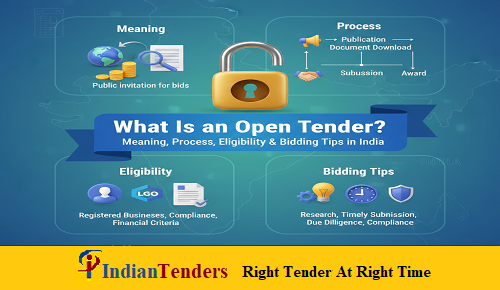
Open tender is a procurement method in which government department, PSU, or public authority all these and other buyers invites bids from all eligible suppliers through public advertisement.
There are no restrictions on participation, except the eligibility criteria defined in the tender document.
In simple words: An open tender allows any qualified bidder to compete, ensuring transparency, competition and fairness in public procurement.

Legal and Regulatory Framework for Open Tenders in India
Open tendering in India is not optional it is legally preferred under multiple procurement frameworks, such as:- General Financial Rules (GFR), 2017
- Central Vigilance Commission (CVC) guidelines
- State procurement rules
- PSU specific procurement manuals
What Indian Rules Emphasise
Indian procurement rules stress:- Wide publicity
- Equal opportunity
- Fair and transparent evaluation
- Avoidance of favouritism
Key Characteristics of Open Tenders
Open tenders have some defining features that separate them from other tender types:- Public advertisement on official platforms
- Unlimited participation of eligible bidders
- Clearly defined eligibility conditions
- Objective evaluation criteria
- Documented scoring and award process
- Post award transparency
How Open Tendering Differs from Other Tender Types
Open tendering is different from limited or single tenders in many ways:| Aspect | Open Tender |
| Participation | Open to all eligible bidders |
| Advertisement | Mandatory public notice |
| Competition | High |
| Transparency | Maximum |
| Legal scrutiny | Very high |
| Use case | High value / critical procurement |
Types of Open Tenders in India
Open tenders can be issued in different formats, such as:- Single stage, two bid system (Technical + Financial)
- Two stage bidding (Pre qualification followed by price bid)
- Item rate tenders
- Percentage rate tenders
- Turnkey / EPC tenders
How Open Tendering Works: Step by Step Process
- Preparation and Planning The buyer defines:
- Scope of work
- Budget estimate
- Eligibility criteria
- Evaluation methodology
- Public Advertisement The tender is advertised on:
- Government eProcurement portals
- Department or PSU websites
- Tender platforms
- Invitation to Bid All interested bidders are invited to participate by downloading tender documents.
- Bid Preparation Period Bidders are given sufficient time to:
- Study documents
- Seek clarifications
- Prepare technical and financial bids
- Bid Submission and Deadline Bids must be submitted:
- Before the deadline
- In the prescribed online/offline format
- Bid Opening
- Technical bids are opened first
- Financial bids are opened only for qualified bidders
- Evaluation and Scoring Evaluation may include:
- Technical scoring
- Financial comparison
- Quality cum cost analysis (QCBS)
- Contract Award The successful bidder is selected based on:
- Eligibility
- Compliance
- Best value or lowest price
- Notification and Publication
Understanding Evaluation in Open Tenders
Evaluation in open tenders is rule based, not subjective.It focuses on:
- Compliance with eligibility
- Technical capability
- Past experience
- Financial reasonableness
When Should Open Tenders Be Used?
Open tenders are preferred when:- Contract value is high
- Public interest is involved
- Competition is required
- Transparency is legally mandatory
Benefits of Open Tenders
For Buyers (Government / PSUs)- Maximum competition
- Better price discovery
- Reduced risk of allegations
- Legal compliance
- Equal opportunity
- Access to large projects
- Business expansion across regions
- Transparent audit trail
- Reduced vigilance risk
- Standardised procedures
Challenges and Limitations of Open Tenders
Despite benefits, open tenders have limitations:- Heavy competition
- Long timelines
- High documentation effort
- Increased rejection risk
- Price undercutting
Best Practices for Bidders in Open Tenders
- Always check eligibility before bidding
- Do not quote blindly low prices
- Track corrigenda carefully
- Maintain proper documentation
- Use bid/no bid analysis
How IndianTenders.in Helps with Open Tenders
Indiantenders.in and It's Bid consultancy team helps bidders assess eligibility, understand tender conditions, reduce rejection risks and prepare better bids, especially in complex open tenders. IndianTenders.in supports bidders at every stage of open tendering:- Verified Open Tenders
- Central and State Government
- PSUs and authorities
- Sector wise coverage
- Smart Filters Filter by:
- Category
- Location
- Tender value
- Deadline
- Early Alerts Timely alerts help bidders prepare instead of rushing.
- Bid Consultancy Support Experts assist with:
- Eligibility review
- Risk identification
- Bid strategy guidance
Conclusion
Open tendering is the backbone of India’s public procurement system. It ensures transparency, fairness and accountability, but it also demands discipline and preparation from bidders.Success in open tenders does not depend only on price. it depends on understanding rule, meeting eligibility, following procedures and bidding strategically. With the right information and expert support, open tenders can become a reliable path for long term business growth.
Tags
Open Tender Meaning, Open Tender Process in India, Indian Government Open Tenders, Public Procurement Rules India, Open Tender Evaluation, Types of Open Tenders , How Open Tendering Works, IndianTenders.in ,Frequently Asked Questions (FAQs) on Open Tenders
1. What is an open tender in India ?An open tender is a public procurement method where any eligible bidder can participate. It is advertised openly to ensure transparency, competition and fairness as per Indian procurement rules.
2. Are open tenders mandatory for government procurement ?
Yes, for high value and important procurements, open tendering is the preferred method under Indian rules like GFR and CVC guidelines, unless there is a valid reason to use another method.3. Who can apply for an open tender ?
Any company, contractor, or MSME that meets the eligibility criteria mentioned in the tender document can apply for an open tender.4. Does “open” mean anyone can bid without conditions ?
No. While participation is open, bidders must strictly meet eligibility conditions such as experience, turnover, technical capabilit and statutory registrations.5. Where are open tenders published in India ?
Open tenders are published on government eProcurement portals, PSU websites, departmental portals and tender platforms like IndianTenders.in.6. What are the key stages in the open tender process ?
The main stages are: Preparation and planning, public advertisement, bid invitation, bid preparation period, bid submission, evaluation, scoring, contract award and notification.7. How are bids evaluated in open tenders ?
Bids are first checked for eligibility and technical compliance. Only qualified bidders move to financial evaluation, where price or value-based scoring is applied.8. Is the lowest bidder always selected in open tenders ?
Not always. If the lowest bidder does not meet eligibility or technical requirements, the bid can be rejected even if the price is lowest.9. Are open tenders suitable for MSMEs ?
Yes, but MSMEs should apply selectively. They should focus on open tenders where eligibility requirements are realistic and aligned with their capacity.10. What are common reasons for rejection in open tenders ?
Common reasons include not meeting eligibility criteria, incomplete documents, incorrect formats, missing deadlines, or ignoring corrigenda.11. What is the difference between open tender and limited tender ?
Open tenders are publicly advertised and open to all eligible bidders, while limited tenders are issued only to selected or registered vendors.12. Why is competition high in open tenders ?
Because there is no restriction on participation, many bidders compete, including experienced national players, which increases competition.13. What documents are usually required in an open tender ?
Typical documents include company registration details, past experience certificates, financial statements, statutory compliances and technical proposals.14. How can bidders track open tenders efficiently ?
Using platforms like IndianTenders.in helps bidders track verified open tenders, apply filters, receive alerts and avoid missing deadlines.15. How does Indiantenders.in and its bid consultancy team help in open tenders ?
Indiantenders.in and its Bid consultancy team helps bidders assess eligibility, understand tender conditions, reduce rejection risks, and prepare better bids, especially in complex open tenders.